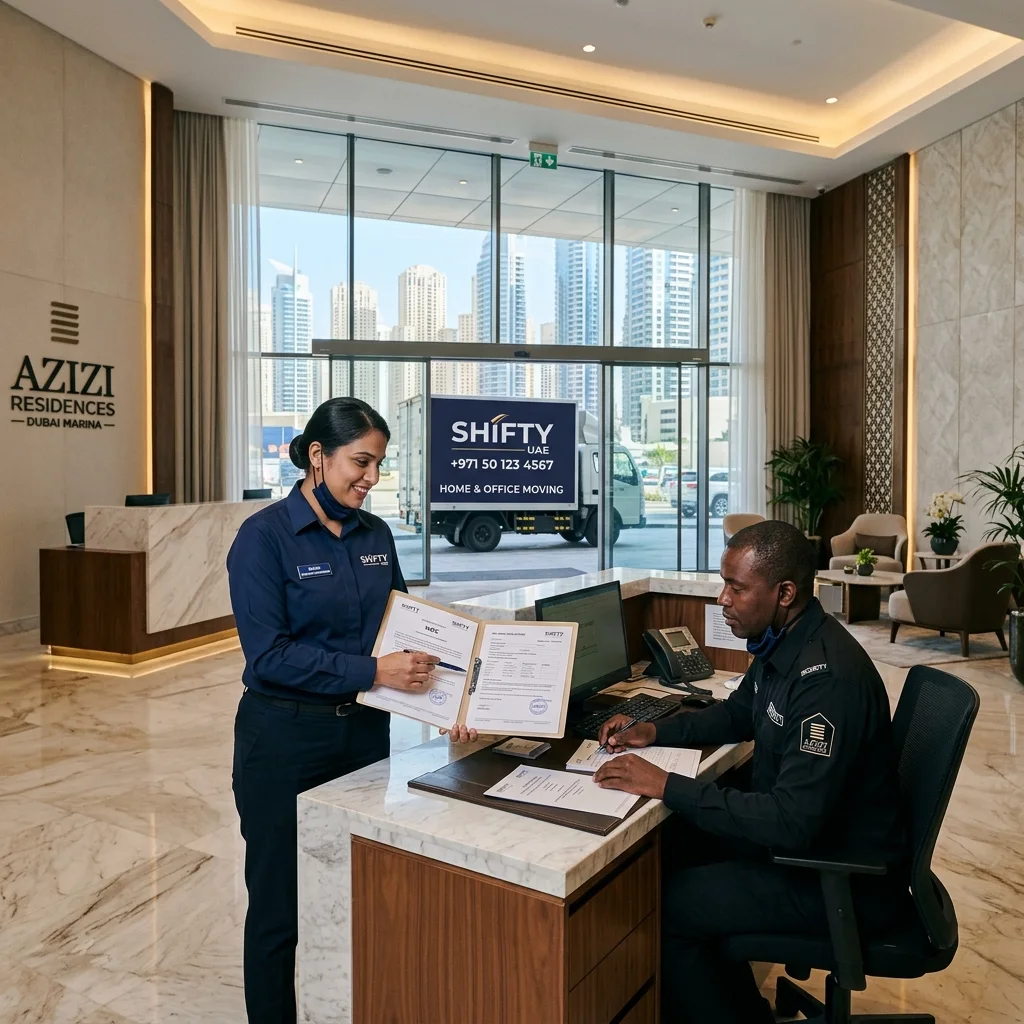
How High-Rise Policies Shape Dubai Moving Companies' Strategies
Written by Ali Khan | Senior Moving Consultant, Shifty UAE. Ali Khan has over 7 years of experience managing residential relocations across Dubai's high-rise communities, including complex permit-managed moves in Dubai Marina, Downtown Dubai, JLT, Business Bay, DIFC, and Palm Jumeirah.
This article was last reviewed and updated in June 2026 to reflect current building management protocols and high-rise moving regulations across Dubai's major residential developments.
Quick Answer Dubai's high-rise buildings enforce strict Move-In/Move-Out permit systems, fixed elevator booking windows, low-clearance loading dock requirements, and refundable damage deposits. Professional moving companies in Dubai build their entire operational strategy around these regulations — from fleet composition and crew structure to permit submission timelines and balcony hoisting capability.
Moving out of a villa in Dubai is primarily a question of volume and packing speed. Moving out of a high-rise apartment is an exercise in logistics, compliance, and advance coordination that begins days before a single box is lifted.
If you have attempted a move in Dubai Marina, Downtown Dubai, JLT, or Business Bay, you already know that building management holds significant operational control over the process. The service elevator booking window, the NOC clearance requirement, the loading dock clearance restriction, the damage deposit — each of these variables can stop a move entirely if the moving company has not prepared for them specifically.
For professional moving companies operating in Dubai's vertical residential market, the ability to execute a high-rise move without delays or penalties depends entirely on how deeply the company has integrated building regulations into its core operational framework. This guide explains each of the major regulatory constraints that shape high-rise moving in Dubai, and the specific strategies that distinguish companies equipped to handle them from those that are not.
Move Planning Timeline
Professional movers do not wait until moving day. Most high-rise relocations in Dubai follow a structured timeline that starts about a week before the scheduled move. This helps secure building approvals, reserve service elevators, coordinate parking access, and avoid last-minute delays.
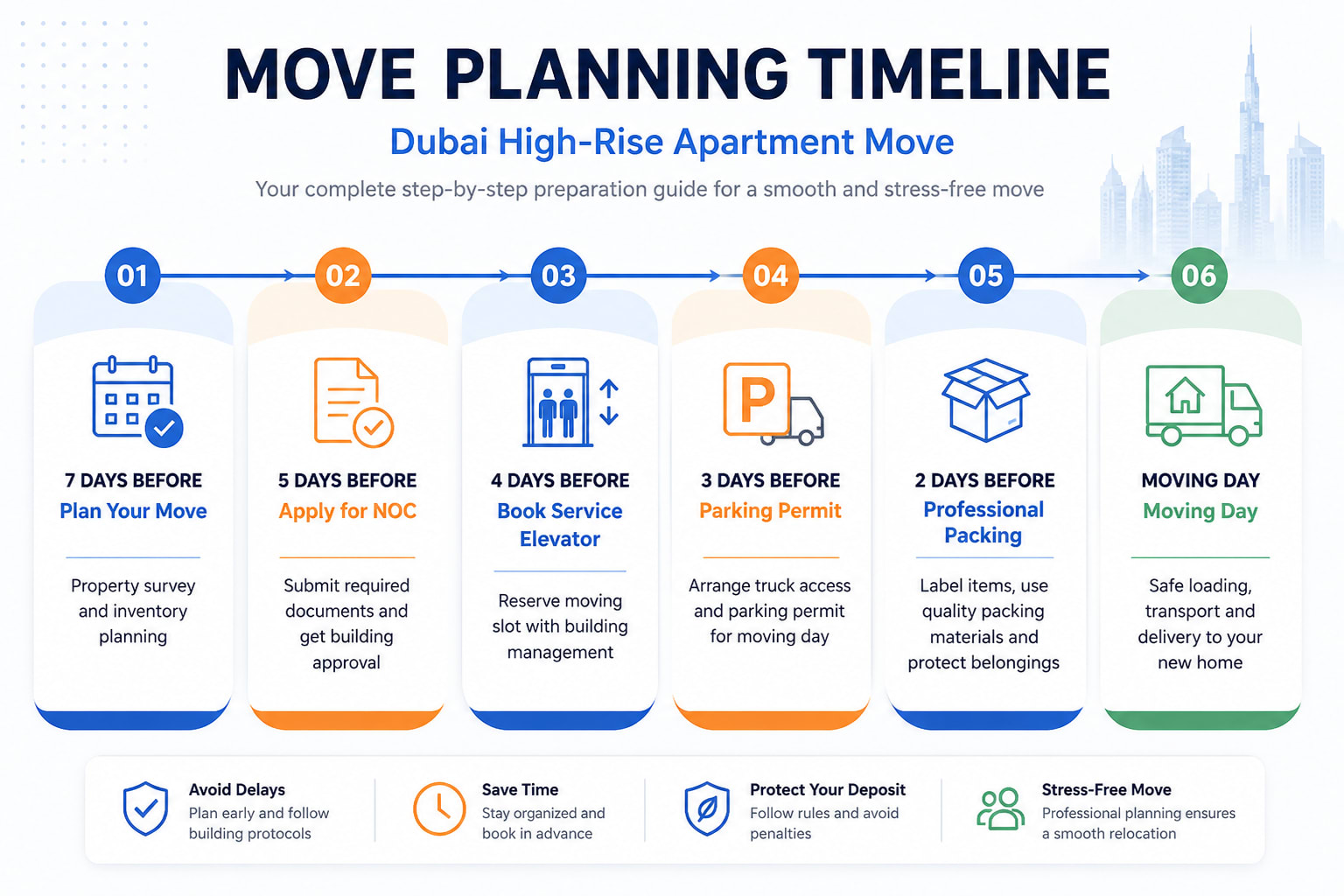
Each stage below explains why every step matters and what can happen if it is skipped.
The Regulatory Landscape of High-Rise Moving in Dubai
Dubai's residential high-rise market is primarily shaped by a small number of master developers Emaar Properties, Nakheel, Dubai Properties, DAMAC, and Meraas alongside hundreds of private Owners Association Management (OAM) companies that manage individual towers or tower clusters within larger developments.
Over the years, these entities have developed detailed Move-In and Move-Out protocols designed to protect building infrastructure, maintain community security, and ensure that the moving process does not negatively affect other residents. These protocols vary in their specific requirements across buildings and developers, but share a common underlying structure.
A professional moving company does not work around these policies. It builds its operational planning, crew structure, fleet composition, and documentation workflow around them.
The NOC: The Document That Controls Everything
The No Objection Certificate, commonly referred to as the NOC or the Move-In/Move-Out Permit, is the foundational document for any high-rise move in Dubai. Without it, building security will not permit a moving truck to access the loading bay, and a moving crew will not be permitted to enter the building with equipment.
What the NOC Requires
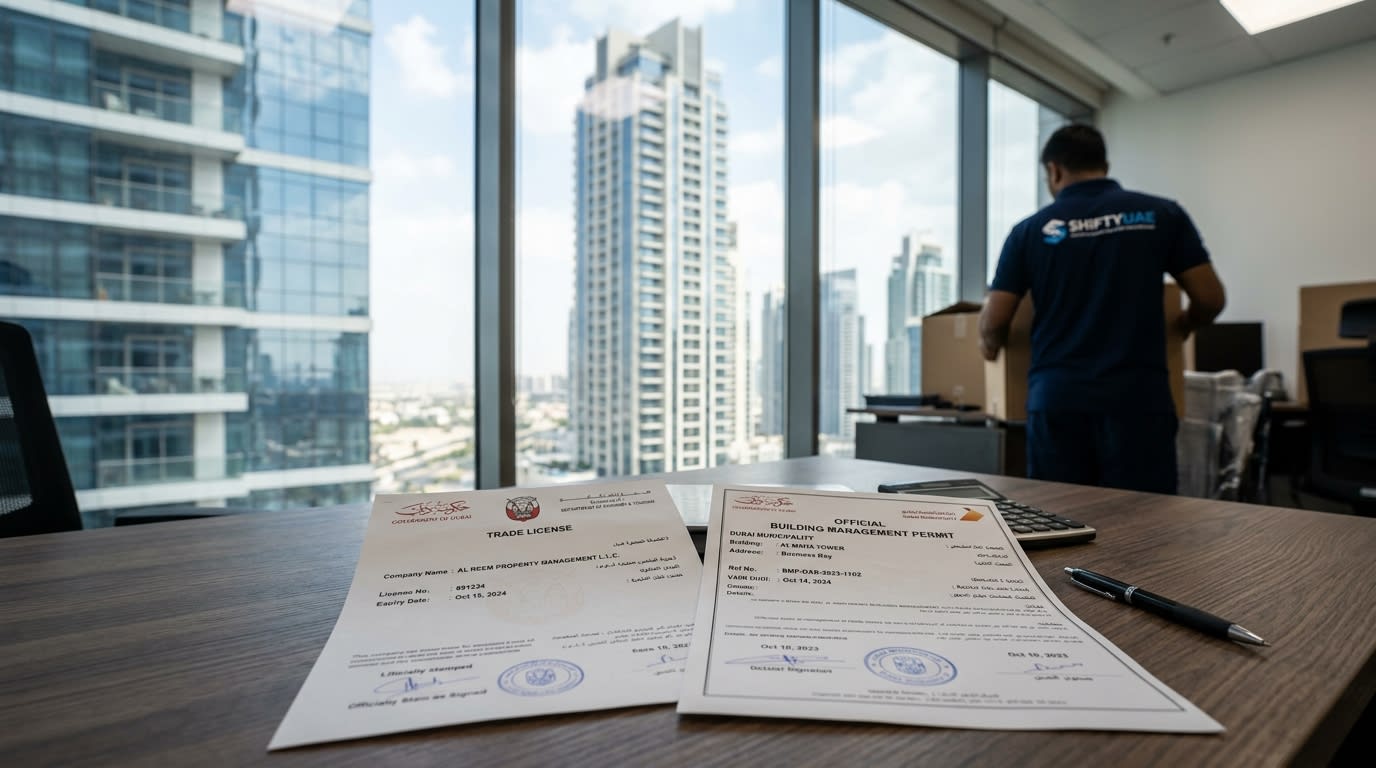
Obtaining a NOC involves two parallel requirements: tenant clearance and company documentation.
On the tenant side, the NOC application typically requires confirmation that all outstanding DEWA bills, Empower (district cooling) charges, building service fees, and chilled water accounts are settled and cleared. In some buildings, particularly those managed by Emaar and Nakheel, a refundable damage deposit must also be paid before the NOC is issued.
On the moving company side, the application requires submission of a valid trade license and proof of liability insurance. Buildings that do not receive this documentation will not issue clearance for the company to operate on the premises, regardless of how much advance notice has been given.
The Strategy: Trigger Documentation Immediately on Booking
The most common NOC-related failure in high-rise moves is late document submission. Residents who book a move one week in advance and assume the NOC will "sort itself out" frequently discover that the management office requires three to five business days for processing, that the office is closed on the day they attempt to submit, or that there is an outstanding charge on their account that they were not aware of.
Professional moving companies trigger the NOC compliance process the moment a booking is confirmed. Company documentation, trade license, and insurance certificates should be provided to the client or submitted directly to the building management portal on the day of booking, not the day before the move. This allows the maximum possible time for any processing delays, outstanding charge discoveries, or documentation queries to be resolved before move day arrives.
For residents planning a high-rise move, confirming with your moving company that this process has been initiated is one of the most important questions to ask following booking confirmation.
For a comprehensive overview of permit requirements across Dubai's major residential developments, the Dubai community regulations guide covers the specific NOC processes for Emaar, Nakheel, DAMAC, and private OAM-managed buildings in detail.
The Service Elevator Time Slot: The Most Constrained Variable
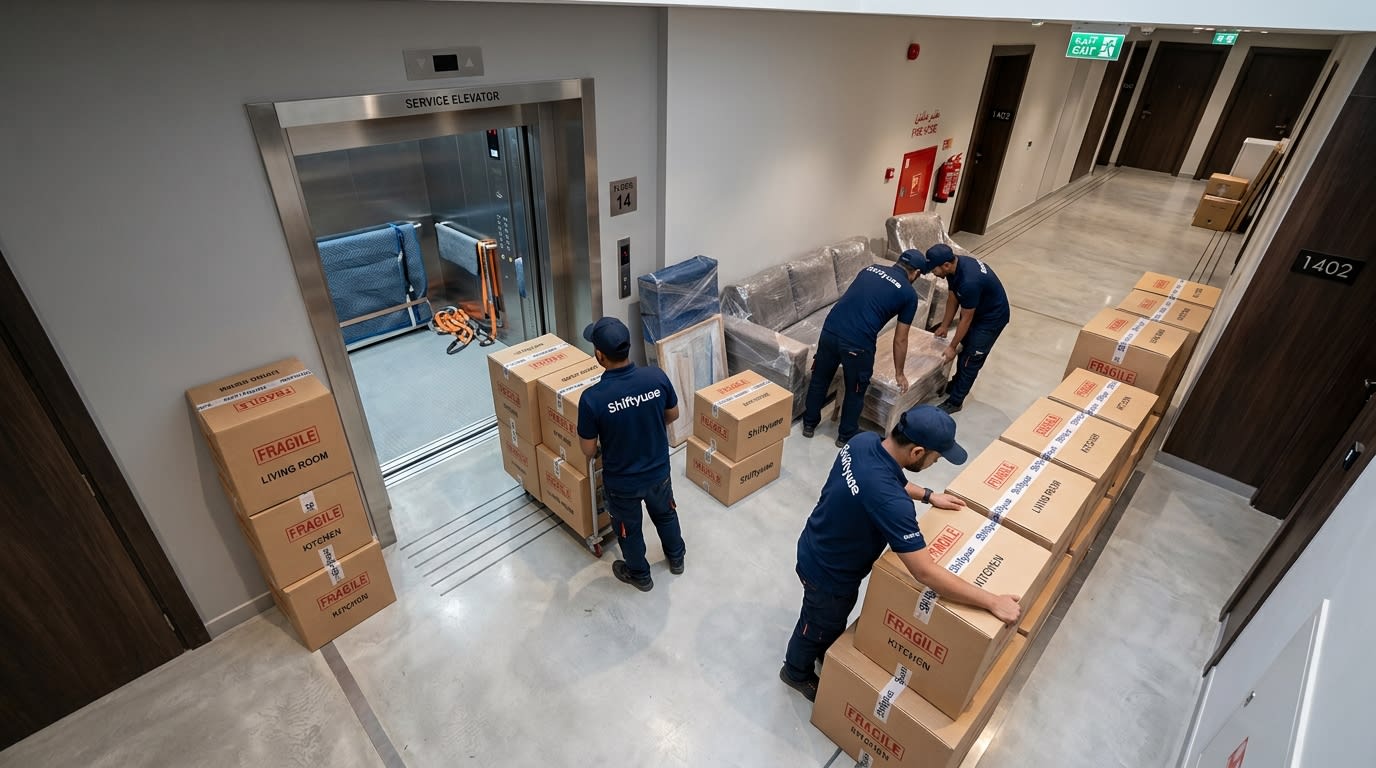
In most Dubai high-rise towers, the service elevator is a shared resource that building management allocates in fixed time windows. Understanding how these windows work and how professional movers maximise their efficiency within them is the most operationally significant aspect of high-rise moving in Dubai.
How Elevator Windows Work
Most buildings permit moves on weekdays between 8:00 AM and 5:00 PM or 6:00 PM. Some buildings restrict moves further, excluding Fridays, Sundays, or public holidays entirely. The service elevator is typically allocated in a single booking window of three to four hours.
For a two-bedroom apartment on a mid-floor, three hours is a manageable window for a well-organised professional crew. For a three-bedroom apartment on the 40th floor or above, three hours is an extremely tight constraint that requires specific crew management to achieve within a single window.
If a move runs over the allocated window, building security has the authority to stop the operation. Items that have not been moved must be left in place and rescheduled for a future slot, which may not be available for several days depending on building demand.
The Strategy: Staging and Cycling
The staging and cycling method is the operational approach professional movers use to maximise throughput within a constrained elevator window.
Rather than following the instinct of walking items from the apartment directly to the truck in a sequential process, the crew is divided into three distinct roles operating simultaneously.
The first team, the packing and staging crew, works continuously inside the apartment, preparing items and moving them to the staging area immediately outside the apartment door and into the corridor approaching the elevator. Their output feeds the elevator continuously without pauses.
The second role the elevator runner manages the elevator exclusively during the window, operating it continuously between the apartment floor and the basement or ground-floor loading level. The elevator does not sit idle waiting for the next load. It moves constantly between a loaded downward journey and an empty return.
The third team, the loading crew, receives items at the basement or ground level and loads the truck in parallel with the elevator operation above. Items transferred from the elevator are moved directly onto the truck without being staged at ground level, maintaining continuous flow.
This three-phase parallel operation significantly increases the volume of items that can be moved within a fixed elevator window compared to a sequential carry-load-return approach.
Buildings With Multiple Service Elevators
Some of Dubai Marina's and Downtown Dubai's larger towers operate two service elevators. When both elevators can be booked for a single move window, the effective throughput doubles. Professional movers familiar with specific buildings confirm the number of available service elevators during the pre-move survey and plan crew allocation accordingly.
For detailed guidance on service elevator booking, access windows, and the logistics of high-rise apartment moves, the high-rise apartment moving guide covers the full process across Dubai Marina, JLT, Downtown Dubai, Business Bay, and DIFC.
Basement Loading Docks: The Clearance Problem
Not all moving trucks can access the loading infrastructure of Dubai's high-rise buildings. This is one of the most frequently encountered and least anticipated obstacles in high-rise moving, and it is entirely preventable with planning.
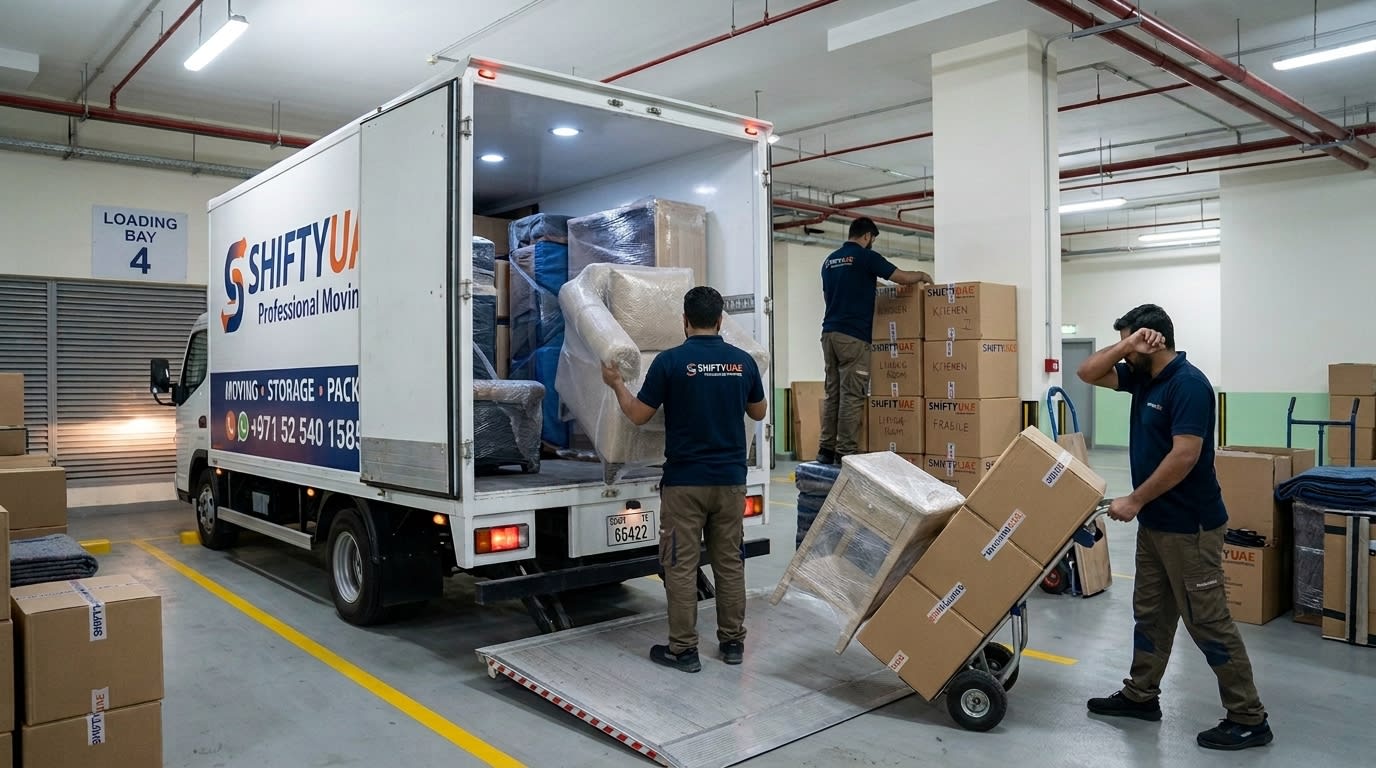
The Clearance Dimension Challenge
Basement loading bays in Dubai Marina, JLT, Downtown Dubai, and Business Bay towers commonly have overhead clearance heights of 2.1 to 2.4 metres. Standard 3-tonne and 5-tonne moving trucks are typically 2.6 to 2.8 metres in height. A truck that cannot enter the basement loading bay must park on the street or in a surface car park.
The consequence is a significantly extended carry distance. Items must be trolleyed from the service elevator, out of the building's ground-floor or basement exit, across a public pavement or car park surface, and loaded onto a truck that may be parked 50 to 200 metres from the building entrance. This adds hours to a move and significantly increases the number of times each item is handled, directly increasing the risk of surface damage.
In some communities, particularly along Dubai Marina Walk and in certain JLT cluster zones, a truck parked outside the designated loading area may also encounter intervention from building security or community management.
The Strategy: Fleet Diversification and Pre-Move Access Assessment
Professional moving companies operating in Dubai's high-rise market maintain a diversified fleet that includes low-clearance vehicles specifically configured for basement loading dock access. These vehicles typically have cargo area roof heights of 2.0 to 2.1 metres, allowing them to access the majority of Dubai's restricted basement bays.
The pre-move survey conducted either in person or via a video walkthrough is the appropriate moment to confirm the specific clearance height of the building's loading dock against the available fleet. Asking a moving company specifically "what is the height of your smallest vehicle and does it fit in our building's loading bay?" before confirming a booking is a direct and reliable way to assess whether the company has considered this constraint.
For a full breakdown of how loading dock access and other access-related factors affect total moving costs, the hidden fees guide explains each potential surcharge in detail.
Protecting the Building: The Damage Deposit
Almost all premium residential towers in Dubai require a refundable damage deposit before a move is permitted to begin. This deposit, typically ranging from AED 1,000 to AED 2,500 depending on the building, is held by building management and released after a post-move inspection of corridors, elevator interiors, and common areas.
Deductions are applied for scratches on corridor walls, chips to elevator tile edges, marks on marble flooring, damage to door frames, and any damage to building fixtures or fittings along the moving route.
The responsibility for protecting the building during a move rests with the moving company. A company that does not deploy building protection measures is placing the client's damage deposit at risk.
The Strategy: Route Armouring Before Any Item Is Moved
Professional moving companies prepare the route before the first piece of furniture leaves the apartment. This preparation, referred to as route armouring, involves deploying a defined set of protective measures along every surface that items will contact during the move.
Corridor floor runners and heavy-duty rubber-backed protective mats are laid along the entire corridor route from the apartment entrance to the service elevator. These runners protect marble, porcelain tile, and hardwood flooring from trolley wheel contact and dropped item impact.
Wall corner guards are fitted on all wall corners along the primary moving route. Corner guards absorb the impact of furniture edges and trolley handles that would otherwise chip plaster or scratch painted wall surfaces at the most vulnerable contact points.
Elevator interior padding, protective blankets or purpose-built elevator pads are secured to the interior walls of the service elevator before any items are loaded. The elevator doors and threshold are also protected from the repeated impact of trolley wheels entering and exiting under load.
Door frame protection is applied to both the apartment entrance door frame and the service elevator door frame, where oversized items create the highest contact risk during transit.
These measures protect the building and the client's damage deposit simultaneously.
The "It Won't Fit" Scenario: Balcony Hoisting
High-rise apartments in Dubai Marina, Downtown Dubai, and JLT were designed with service elevator dimensions that do not accommodate all modern furniture configurations. Custom L-shaped sofas, American-style double-door refrigerators, king-size bed bases with solid wooden frames, grand dining tables, and bespoke shelving systems are among the items most frequently identified as impossible to transit through a standard service elevator or apartment corridor.
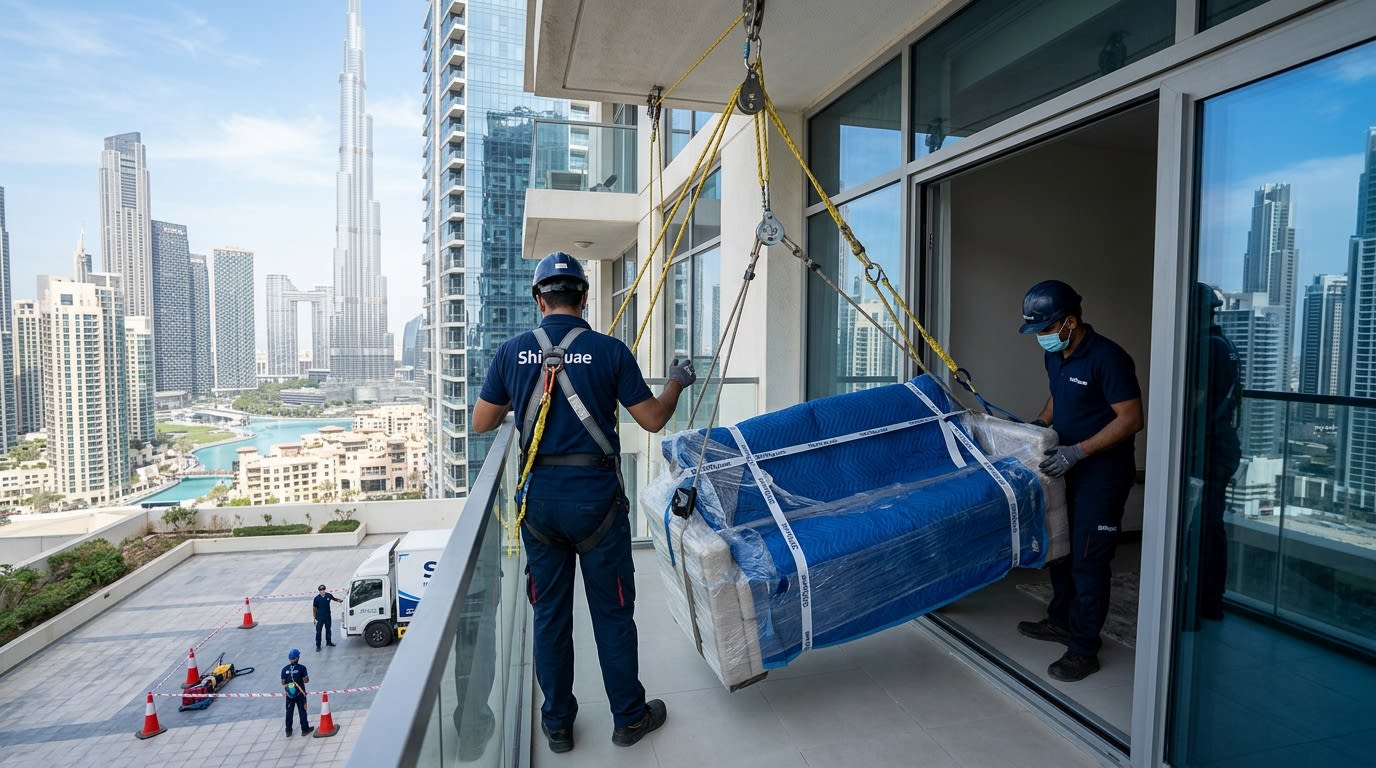
When Balcony Hoisting Is Required
Balcony hoisting, or lifting or lowering an oversized item externally through the balcony opening using a rope and pulley system, is the professional solution when internal transit is not possible. The item bypasses the elevator and corridor entirely, being lifted from ground level or lowered to ground level via the balcony face of the building.
This operation requires specific clearance from building security before it can proceed, a certified rope and pulley rigging system operated by a trained and harnessed crew, and ground-level cordoning to protect pedestrians and vehicles below the hoisting area.
The Strategy: Identify and Plan Before Move Day
Balcony hoisting is not something that should be organised on move day as an improvised solution to an unexpected problem. The pre-move survey is the correct moment to identify any item that may not fit through the service elevator or apartment corridors, and to confirm the plan for that item specifically.
Key dimensions to assess during the pre-move survey include the service elevator door width and internal car dimensions, the corridor width from the elevator to the apartment entrance, and the apartment front door frame width. Any item whose dimensions exceed these measurements should be flagged for hoisting at survey stage, allowing the hoisting equipment and trained crew to be scheduled as part of the standard move plan.
Budget operators without trained hoisting personnel or the relevant safety equipment are not able to offer this as a service. Identifying this capability gap before booking rather than on move day when the option is urgently required is one of the most important differentiators between moving companies in Dubai's high-rise market.
Choosing a Moving Company That Understands High-Rise Regulations
The questions that matter most when selecting a moving company for a high-rise move in Dubai are not about price or packing materials. They are about operational knowledge of building management systems and the company's documented capability to work within them.
Questions to Ask Before Booking
- How do you manage the NOC application process, and when do you submit your company documents?
- What is the roof height of your smallest vehicle, and does it fit in our building's loading bay?
- How do you structure your crew to complete a move within a three-hour elevator window?
- Do you carry hoisting equipment, and is your crew trained and certified for balcony hoisting?
- How do you protect corridors and elevator interiors during a move?
- What happens if there is an outstanding utility charge that delays the NOC?
A moving company that cannot answer each of these questions specifically and immediately is not operationally prepared for Dubai's high-rise building environment.
For guidance on verifying a moving company's trade license, MOHRE compliance, and insurance documentation before booking, the moving company verification guide covers the complete verification process.
High-Rise Move Timing: When to Book
The lead time required for a high-rise apartment move in Dubai depends on the building, the community, and the time of year.
For standard moves in most managed residential towers, a minimum of three to five business days is needed for NOC processing, elevator slot booking, and crew and fleet scheduling. This assumes straightforward NOC processing within 48 hours, which is realistic for most standard applications.
During peak moving periods September through November and March through May, demand for professional apartment movers in Dubai increases significantly. A seven to ten business day lead time provides a reliable buffer during these periods. Premium towers in Downtown Dubai, DIFC, and Palm Jumeirah benefit from ten or more business days of preparation, given the more detailed NOC and permit requirements in these communities.
Frequently Asked Questions
What permits are required for a high-rise move-in in Dubai?
Almost every managed high-rise tower in Dubai requires a Move-In or Move-Out permit (NOC) issued by the building's facility management team before any moving activity is permitted. The NOC application requires the tenant to clear all outstanding DEWA, Empower, and building service charge accounts, pay a refundable damage deposit, and provide the moving company's trade license and insurance documentation. Processing typically takes 24 to 48 hours in standard towers.
How do moving companies in Dubai handle the three-hour elevator window?
Professional moving companies use a staging and cycling approach that divides the crew into three simultaneous roles: a packing and staging team working inside the apartment, a dedicated elevator runner managing continuous elevator operation between the apartment floor and the loading level, and a loading team receiving items at ground or basement level and loading the truck in parallel. This parallel operation maximises the volume of items that can be moved within a fixed elevator window.
What is the standard clearance height for Dubai high-rise loading bays?
Basement loading bays in Dubai Marina, JLT, Downtown Dubai, and Business Bay towers commonly have overhead clearance heights of 2.1 to 2.4 metres. Standard moving trucks are typically 2.6 to 2.8 metres in height and cannot access these bays. Professional moving companies operating in Dubai's high-rise market maintain low-clearance vehicles specifically for basement loading dock access.
What is balcony hoisting and when is it used in Dubai apartment moves?
Balcony hoisting is used when oversized furniture items cannot transit through the service elevator or apartment corridors due to dimensional constraints. The item is lifted or lowered externally through the balcony opening using a certified rope and pulley system, with trained and harnessed crew and ground-level cordoning. Items that commonly require hoisting in Dubai high-rise apartments include oversized sofas, large dining tables, and oversized refrigerators.
What happens if a move exceeds the service elevator booking window?
Building security has the authority to stop the moving operation when an elevator booking window expires. Items that have not been moved must remain in place until a new elevator slot is booked, which may not be available for several days depending on building demand. Professional movers prevent this by accurately assessing item volume during the pre-move survey and deploying sufficient crew to complete the move within the allocated window using the staging and cycling method.
How do professional movers protect the damage deposit during a high-rise move?
Professional movers deploy route armouring before any item is moved: heavy-duty floor runners in corridors, corner guards on wall edges, protective padding inside the service elevator, and door frame protection on the apartment entrance and elevator door frame. These measures protect building surfaces from damage during the move, directly reducing the risk of deductions from the refundable damage deposit.
How far in advance should I book a high-rise apartment move in Dubai?
A minimum of three to five business days is recommended for standard high-rise moves, allowing time for NOC application, elevator slot booking, and crew scheduling. During peak moving periods, September to November and March to May, seven to ten business days are appropriate. Premium developments in Downtown Dubai, DIFC, and Palm Jumeirah benefit from ten or more business days of lead time due to more detailed permit requirements.
About the Author
Ali Khan, Senior Moving Consultant, Shifty UAE
Ali Khan has over 7 years of experience managing residential relocations across Dubai's high-rise communities, with specialist operational knowledge of the permit systems, elevator logistics, loading dock infrastructure, and access protocols of towers in Dubai Marina, JLT, Downtown Dubai, Business Bay, DIFC, and Palm Jumeirah. He has overseen hundreds of high-rise apartment moves, including complex multi-floor relocations within restricted elevator windows and balcony hoisting operations for oversized items.
Shifty UAE is a fully licensed and insured moving company operating from Al Nakheel Center, Deira, Dubai. Low-clearance vehicles for basement loading dock access. Permit and NOC management included on all bookings. Certified balcony hoisting team available. +971 52 540 1585 | info@shiftyuae.com | shiftyuae.com
Related Articles
- 5 Tips for Hassle-Free Apartment Relocation in Dubai
- Difference Between Apartment & Villa Mover Explained | Dubai
- Apartment Moving Checklist | What Most People Forget
- Apartment Moving Services: Complete Step-by-Step Guide
- Moving to a new apartment in Dubai Marina
- Expert Apartment Movers in Dubai Marina: Complete Guide
- High-Rise Apartment Moving in Dubai (Marina & JLT Guide)
- Office Relocation Cost in Dubai 2026 Guide: Complete Pricing, Planning & Moving Guide
- DIY vs Professional Movers in Dubai: What Makes House Shifting Easier with Shifty UAE
- Shifty UAE's Guide: How to Choose the Best Movers in Dubai Sports City?
- Movers in Dubai Offer Same-Day Service: Fast Moving Solutions by Shifty UAE
- Furniture Installation Guide: What’s Included When You Hire Shifty UAE Movers in Dubai
- Apartment Movers Dubai: A Guide for Marina, JLT & DIFC Residents
- House Furniture Movers in Dubai: A Complete Guide to Safe and Professional Furniture Moving
- Average Cost of Moving Company in Dubai: Complete 2026 Pricing Guide by Shifty UAE
- Movers and Packers in Dubai: A Stress-Free Way to Move with Shifty UAE
- Residential Movers in Dubai: The Complete Guide to a Stress-Free Home Move
- Movers and Packers in Dubai: Why Shifty UAE Is the Name People Trust